See the Person Beyond the Name Tag
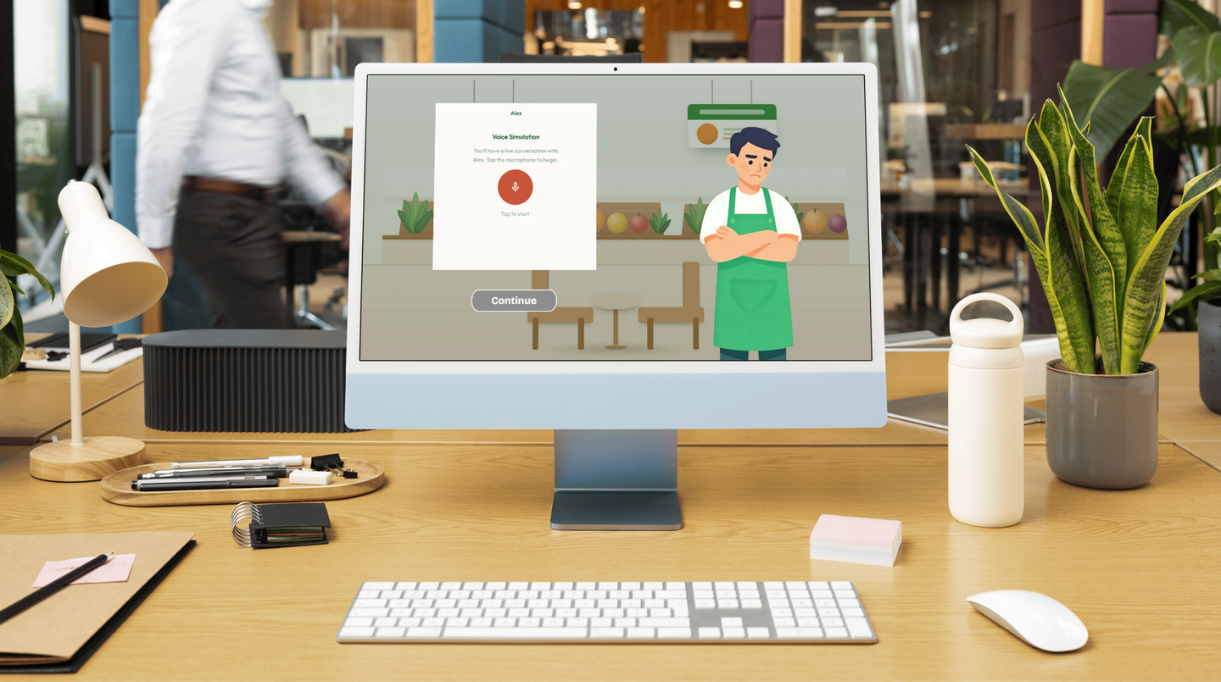
I built this voice simulation demo to explore what becomes possible when generative AI powers the conversation inside an eLearning module. Instead of clicking through multiple-choice questions, the learner steps into the role of a store manager and has a live, spoken coaching conversation with an AI character who responds in real time.
The character's emotional state shifts based on how well the learner coaches, turning a passive lesson into engaging practice. This was a self-initiated build, scoped intentionally as a demo to show what the tools can do.
Audience: Managers and team leaders
Tools Used: Storyline 360, devlin.ai, Claude Design, Magnific (formerly Freepik), Canva
The Problem
Leadership and coaching are conversation skills, and conversation skills don't transfer from reading about them. Most soft-skills eLearning leans on "what would you say?" or “which is the most appropriate response?” multiple-choice branching, which can't capture the live, unscripted feel of talking to another person. Learners walk away knowing the theory but having never practiced the actual skill, not to mention the lack of effective tailored feedback.
Business Cost
When managers aren't equipped for real coaching conversations, the people most capable of growing get overlooked. We don't just want managers who fill a role. We want managers who see the person behind the name tag and help develop them into leaders, into people who self-actualize and become pillars of the organization. Growing our own people is how a company builds bench strength from the inside, and it starts with intentionality and then the quality of one conversation.
The cost of getting this wrong:
Capable people coast and quietly disengage because no one draws out their potential
Hard conversations get avoided, so coaching that should build leaders never happens
Growth and retention suffer, and the organization keeps hiring out for what it could have grown within
The Solution
I designed a single-scenario voice simulation where the learner plays a store manager having a one-on-one growth conversation with a team member named Alex. Alex is reliable and well-liked but has been coasting, so the goal is to draw out what Alex genuinely wants, not to correct performance and not even to make suggestions, at least not at first.
The learner speaks naturally, and devlin.ai drives Alex's spoken responses and facial expressions in real time, shifting from guarded to engaged as the coaching lands. Built in Storyline 360 with devlin.ai integrated as a web object, the simulation uses JavaScript variable triggers to connect the learner's input to Alex's emotional feedback. That feedback loop is the heart of it: the quality of the learner's questions becomes visible in how Alex responds.
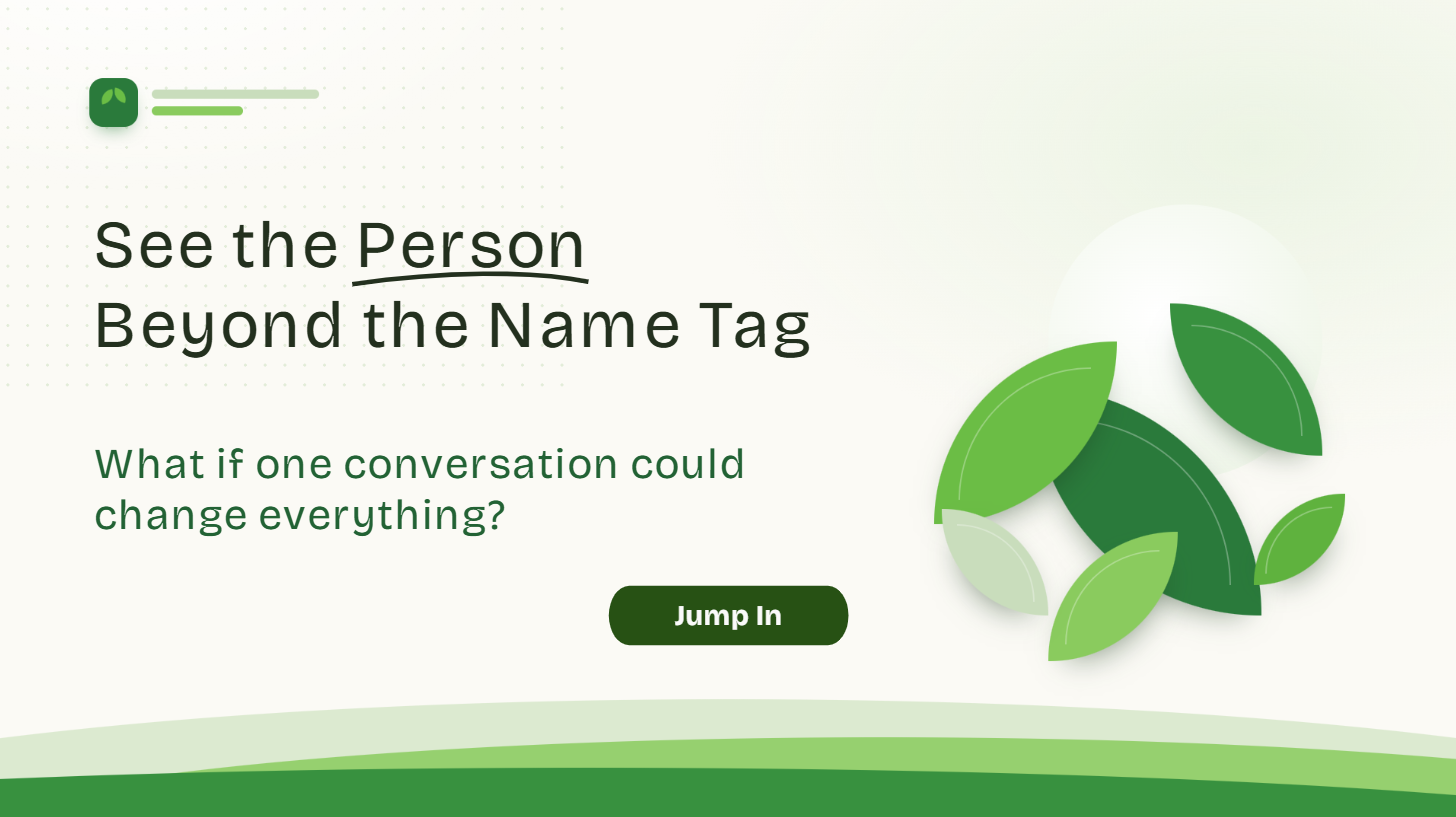
Title Slide: The learner is invited to consider the impact of an intentional conversation.
Simulation in action: Alex moves from from thinking to engaged as the coaching lands.
Design Challenges & Constraints
This was scoped as a focused demo on an accelerated timeline, so a few decisions traded depth for speed without breaking the core experience:
Single scenario, no branching tree. A full build would include multiple decision points and consequence paths.
Static tip content. A fuller version would surface coaching tips that respond to the learner's actual input.
Expanded expression states. A production build would tie more granular emotional feedback to specific input patterns.
Sim Evaluation Criteria. This lean demo had to allow the user to quickly, yet realistically demonstrate performance in the simulated conversation.
The biggest design decision was framing this as a growth conversation, not a performance correction. That distinction shaped the scenario, the copy, and the kind of feedback Alex gives.
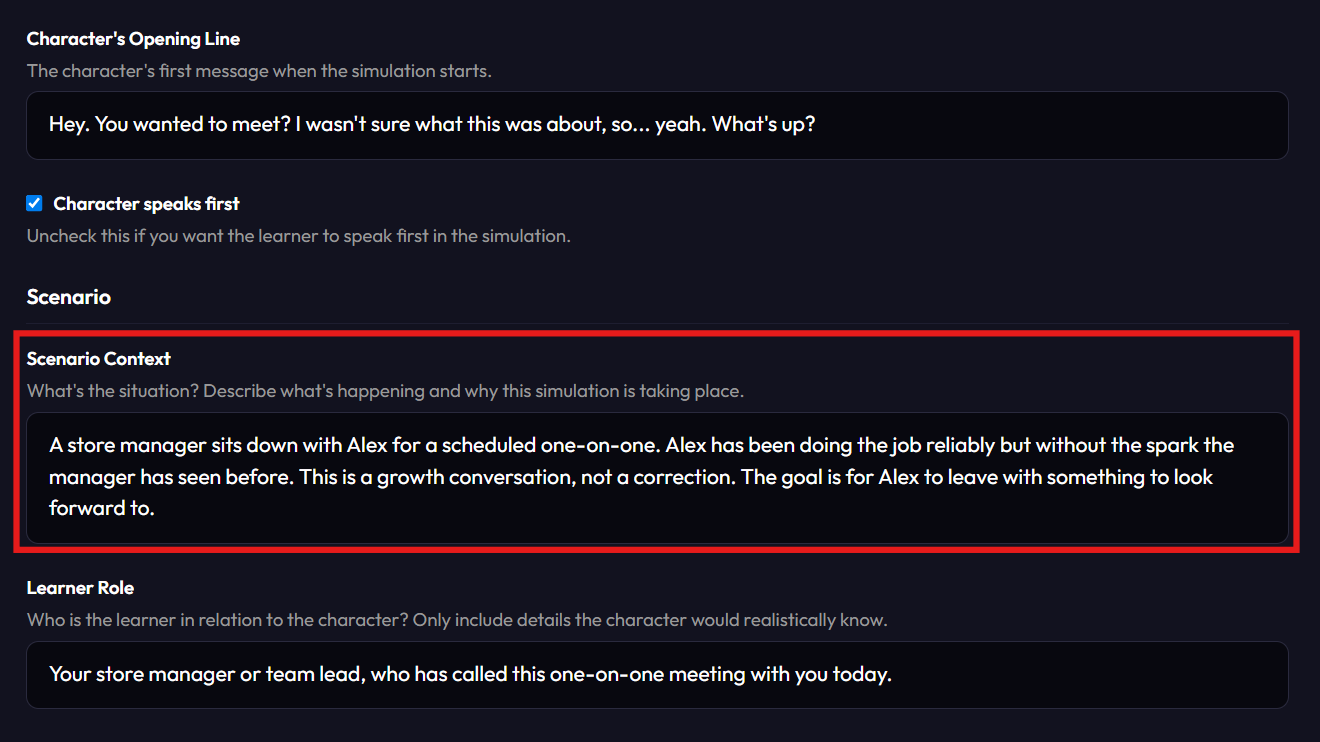
Scenario Context: The scenario description in the devlin.ai dashboard clearly frames the simulation as a growth conversation.
The Design Process
I worked discovery-first, the same way I approach client projects: define the outcome, then design backward from it.
Scenario design
I chose a growth conversation because it's high-stakes, relatable, and benefits uniquely from simulation. I defined clear learning goals up front:
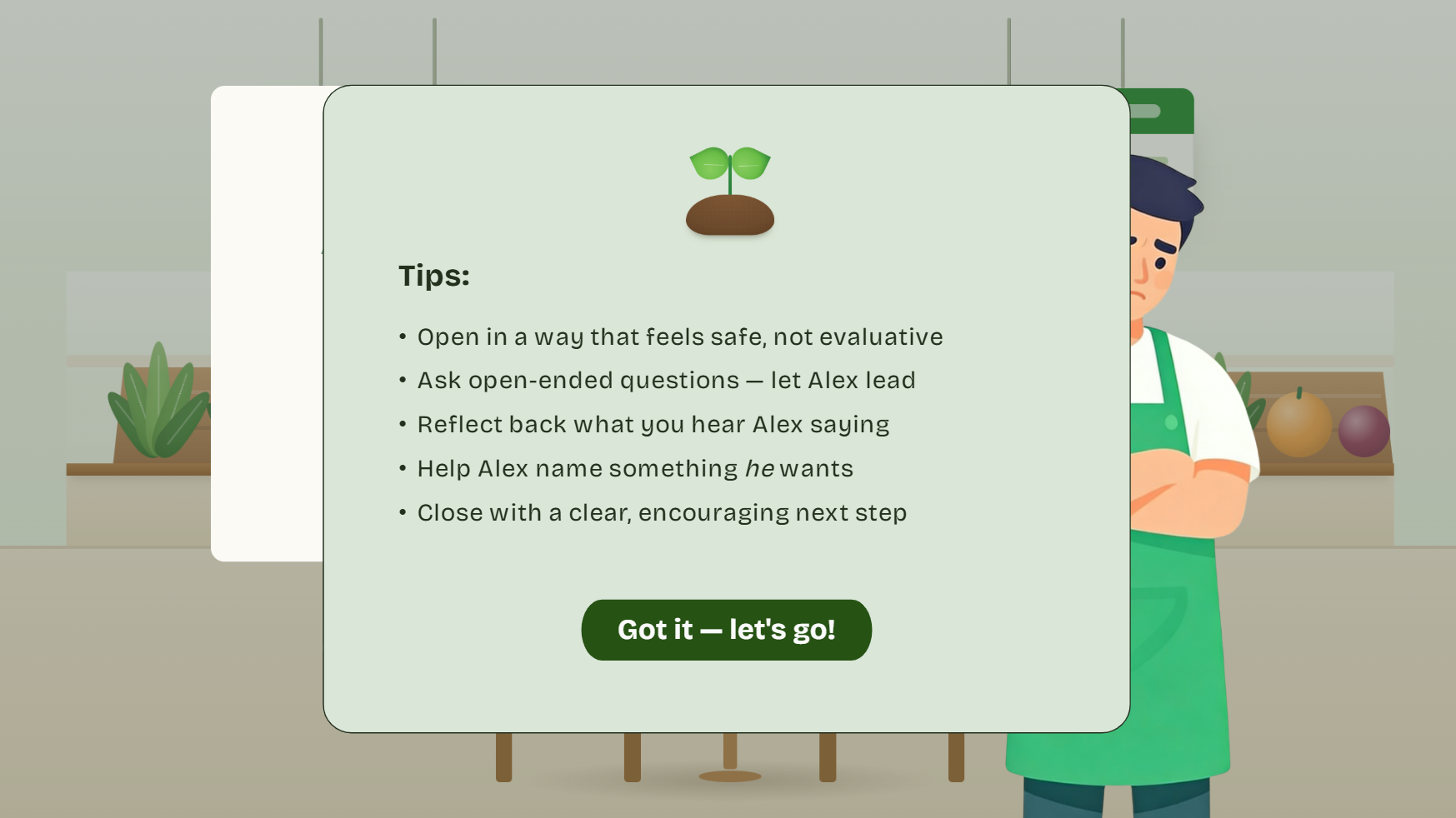
Open in a way that feels safe, not evaluative
Ask open-ended questions that invite reflection
Reflect back what Alex says at least once
Surface Alex’s interests instead of prescribing a direction
Land on one growth goal Alex feels ownership over
Close with an encouraging, concrete next step
Configuring the AI
Alex's behavior is shaped through devlin.ai's platform dashboard, which gives the designer real control over the character. From there I:
Set the context Alex operates in
Defined the behavior triggers that govern how he responds
Established the conditions that end the conversation
Built the evaluation criteria the simulation measures the learner against.
Those criteria drive the outcome the learner sees at the end, so the scoring isn't arbitrary. It maps back to the coaching behaviors the scenario is teaching.
Visual Design
I built a warm, flat illustrated look with an earthy palette of sage green, cream, terracotta, and honey gold, themed around the idea of a natural and organic grocery chain. I generated the slide backgrounds and a set of small supporting illustrations in Claude Design: a name tag reading “Alex”, two chairs facing each other to suggest the conversation, and a sprout emerging from soil suggesting growth. I then used those assets as style inspiration to create a custom character set in Magnific, so the people and the spaces felt like they belonged to the same world. The sprout motif carries all the way through to the feedback slide, where Alex holds a seedling. Canva handled the final format fine-tuning to keep everything consistent across slides.
Build
The module is built across four slides: title, scenario intro, the simulation slide with the devlin.ai sim web object, and a feedback slide.
I built a two-layer tip system so learners get support without interrupting the conversation. An initial layer triggers on hover before the sim starts to give the learner “just in time” support and closes on click. A revisitable Tips layer is then accessible at any point thereafter through a sprout icon.
The feedback slide closes the loop: depending on whether the learner passes, Alex appears in a posture and emotional state that match the outcome, paired with tailored AI feedback on how the conversation went, so the result connects directly to the coaching behaviors they practiced.
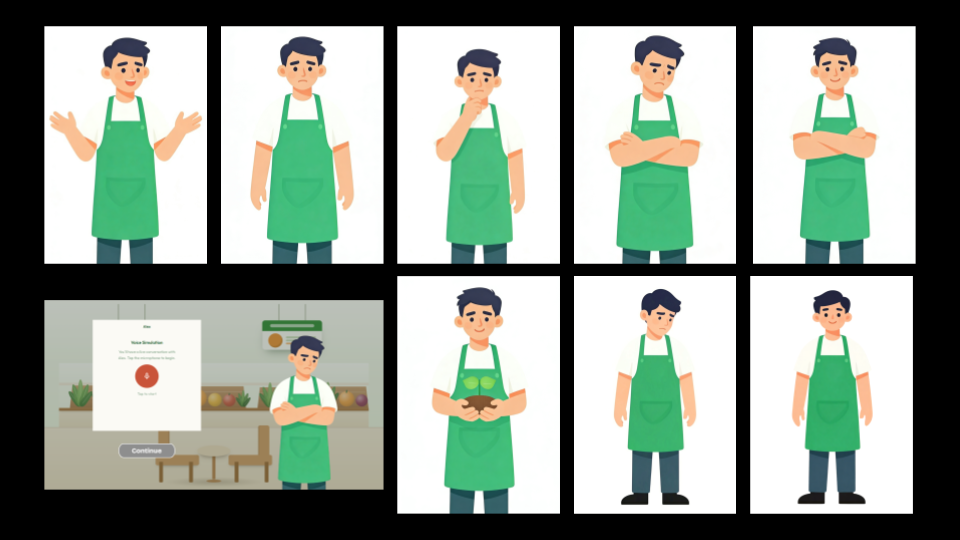
Character Design: Magnific was used to generate a consistent AI character set across multiple poses and expressions.
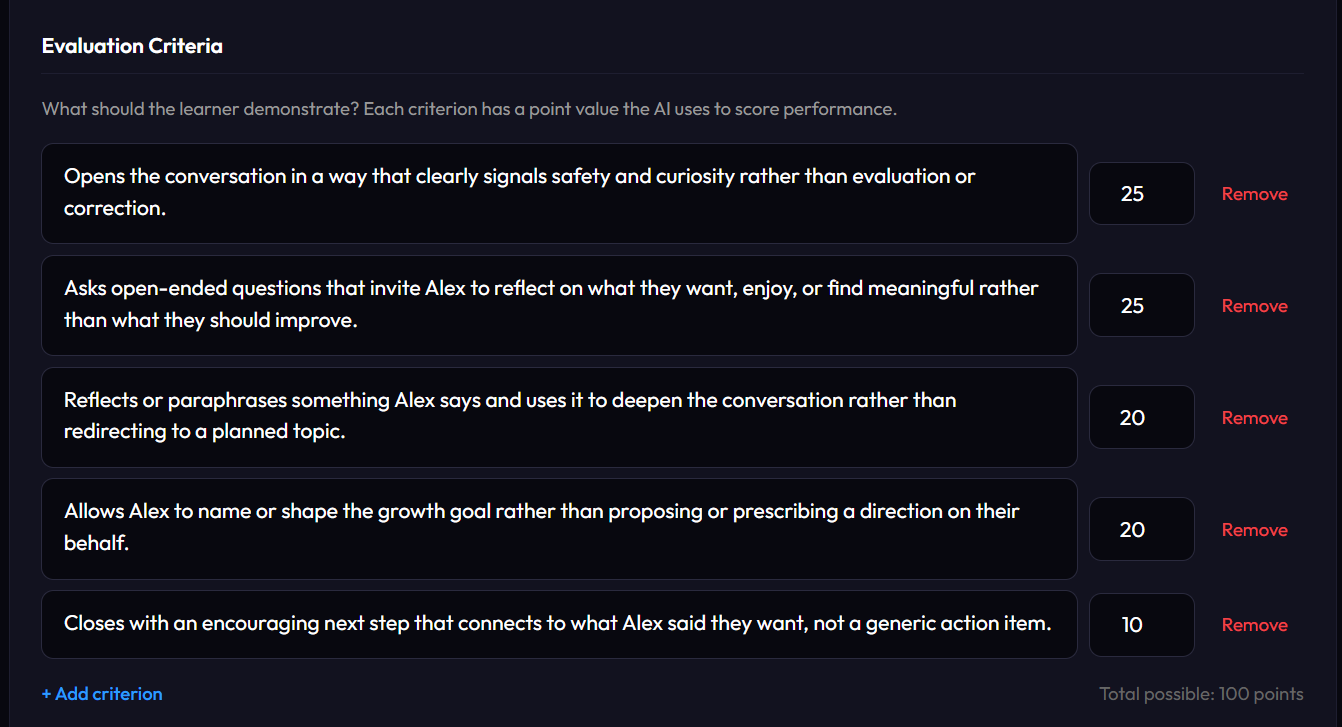
Evaluation Criteria: The simulation scores learner performance against weighted coaching criteria configured in devlin.ai.
Testing and Feedback
I ran the full module past two colleagues and my 10-year-old daughter, on the theory that if a 10-year-old can follow the flow and complete the conversation, the design is clear enough to carry any adult learner. Watching them move through it confirmed the feedback loop felt meaningful end to end and surfaced a few changes worth making.
Feedback-driven changes:
Removed a redundant "Try Again" button. Inside the sim widget, the "Try Again" button competed with the Continue button that activated once the Sim_Eval_Complete variable changed. Two options at the same moment created confusion, so I cut "Try Again" to leave one clear path forward.
Adjusted the conditions that ended the simulation. Initially the conversation could close before the learner had a chance to offer a next step, even after Alex surfaced what he wanted to grow toward. I tuned the end conditions so the learner always gets to land that final, encouraging step, which is one of the core skills the scenario teaches.
Added the Tips layers on the sim slide. Testing showed learners wanted support both before and during the conversation, so I built in the tip layers to give them coaching reminders going in and a way to revisit them mid-sim without restarting.
Live validation: A program leader reacts in real time as the system successfully generates her first complete lesson plan during the group onboarding session.
Reflection
What surprised me most was how little fine-tuning the AI experience needed. I expected to spend significant time wrestling with the model, but devlin.ai is thoughtfully built and doesn't skimp on quality. The voice I chose captured exactly the guarded, coasting attitude I was after. AI voices have come a long way, and this one carried real emotional nuance.
The build stretched me in an unexpected place. I'm used to designing for emotion, since emotion drives learning, but this was a new application of that instinct. I had to think through Alex's emotional states and translate them into facial expressions and body positions, which pushed my prompting in Magnific. Once I had a strong set of characters built, adding new emotional states for Alex got much easier.
I'd love to keep integrating text and voice simulations into projects where they're the right learning solution. The applications are everywhere. This kind of work also fits the direction I've always leaned, designing personalized experiences, and feels like a natural next step.
One thing I'll carry forward: as AI takes on more of the experience, I want to keep adding moments of delight and what I call "humanity checks," small signals that remind people a human designed this. The technology is impressive, but the care behind it is the point.