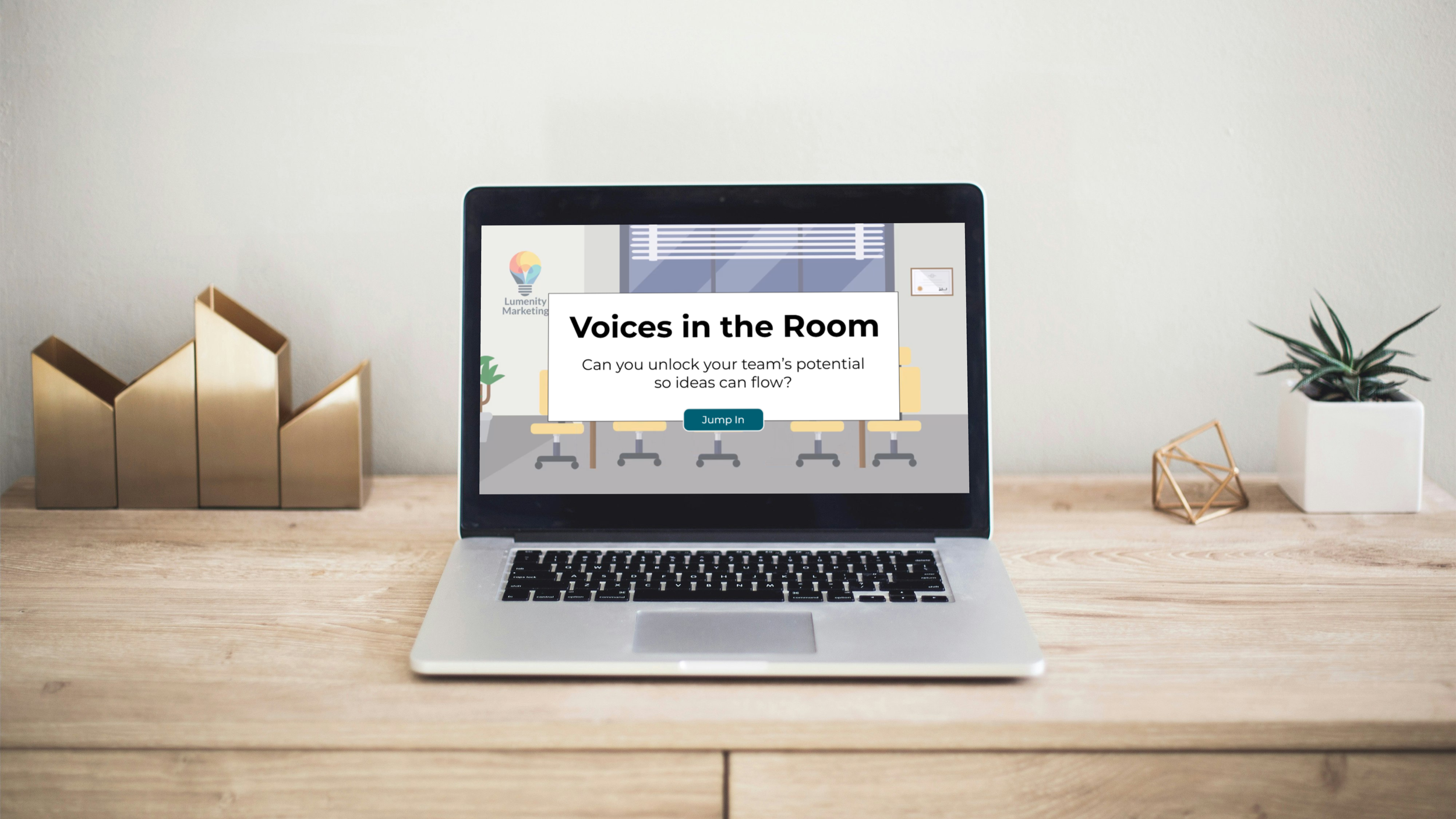
This concept project is a scenario-based eLearning experience where team leaders practice inclusive leadership by creating the conditions where all team members feel safe contributing their best ideas.
Audience: Mid-level managers and team leaders
Responsibilities: Instructional Design, Action Mapping, Storyboarding, eLearning Development, Graphic Design
Tools Used: Articulate Storyline 360, Vyond, Figma, Mindmeister, Freepik
The Problem
Team leaders at Lumenity Creative, a fictitious mid-sized marketing agency, were running meetings where only a few voices were consistently heard. Quieter team members and newer hires often held back—not due to a lack of ideas, but because they didn’t feel safe or invited to contribute. As leaders missed these signals and relied on the same perspectives, teams struggled to generate breakthrough ideas when it mattered most.
The Solution
Non-learning approaches, such as hiring for inclusive leadership or encouraging employees to speak up, were unlikely to address the immediate behavioral gaps leaders were demonstrating in meetings. The core issue required leaders to practice inclusive behaviors, not just hear about them.
I selected a scenario-based eLearning simulation to let leaders make decisions, experience consequences, and build confidence in a safe, scalable environment for a distributed workforce.
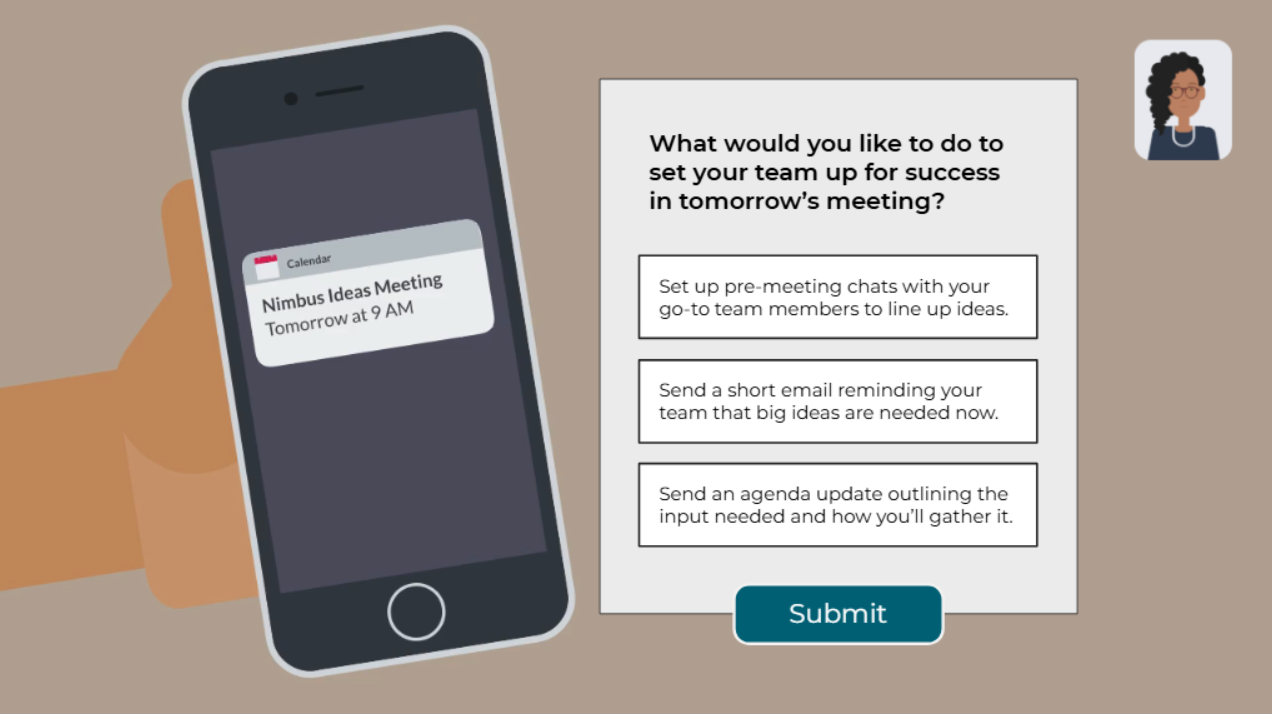
First Decision Point: Leaders practice real meeting decisions and experience the impact of their choices.
My Process
Using the ADDIE framework, I began with the “backward design” process of Action Mapping alongside a marketing SME to identify the leadership actions that most impact inclusion and idea generation. These insights guided the scenario design, text-based storyboarding, visual mockups, and development of the prototype and full experience in Articulate Storyline 360—a powerful authoring tool that allows for excellent interactivity.
Action Map
I worked with a marketing SME who designs large-scale meeting experiences for clients. Through our email exchanges, she confirmed my problem/solution analysis and helped identify the highest-impact leadership behaviors that influence meeting outcomes.
Together, we created an action map focused on what leaders must do before, during, and after key meetings. Rather than emphasizing what leaders should know about inclusive leadership, I prioritized observable actions—such as setting expectations, structuring participation, and responding to ideas.
This approach narrowed the scope to a small set of observable behaviors that directly shaped the scenario decisions and consequence design.
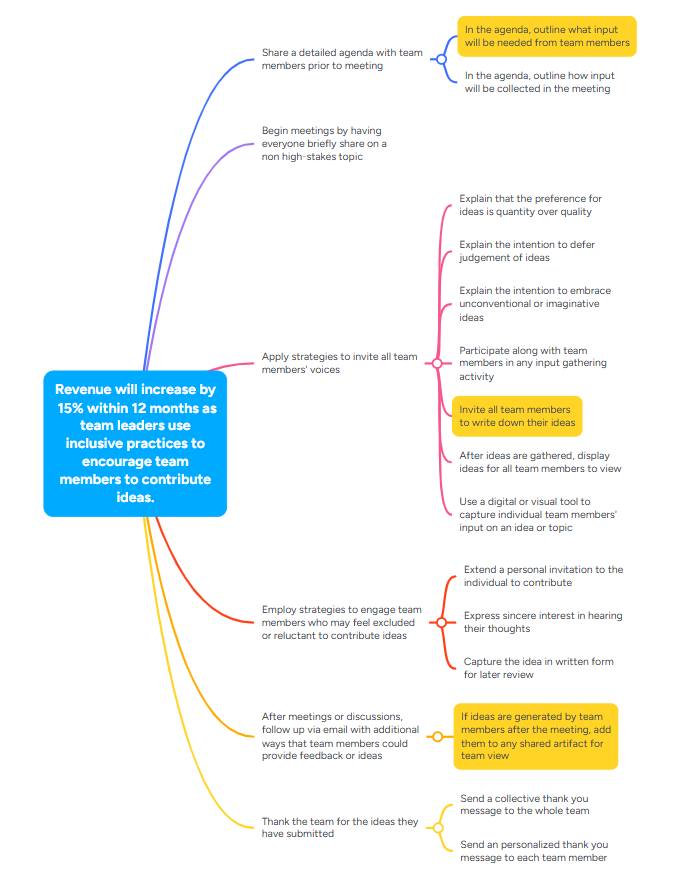
Action Map: Aligning the 15% revenue growth goal to three observable leadership behaviors.
Text-Based Storyboard
I created a text-based storyboard to serve as the blueprint for the experience, outlining the narrative, decision points, and consequence flows before development.
The story immerses learners in a realistic leadership situation, using montage-style consequence scenes to show the human and business impact of each decision rather than explain it. A mentor character provides optional, on-demand guidance without breaking immersion.
The experience was structured using scenario-based learning and Gagné’s Nine Events of Instruction to hook attention early and reinforce behavior change through contextual feedback.
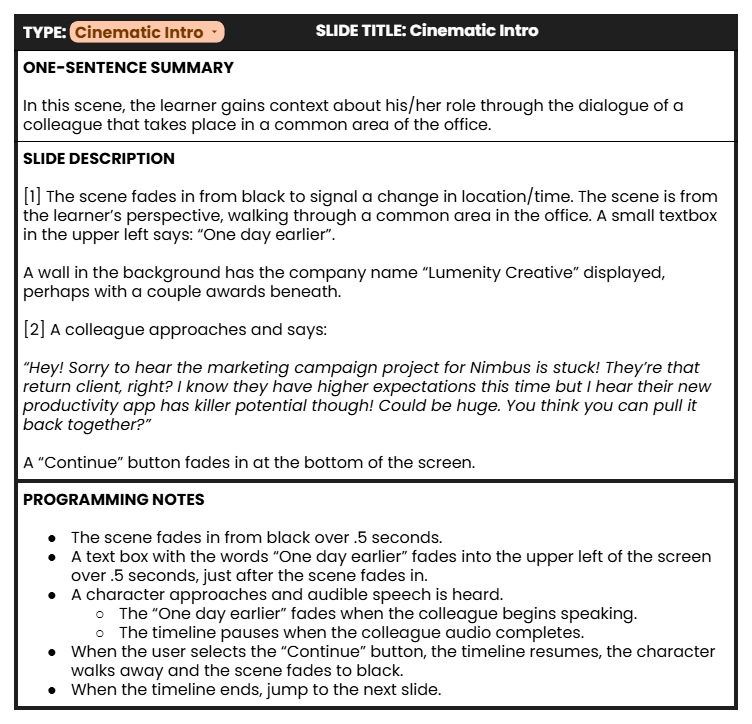
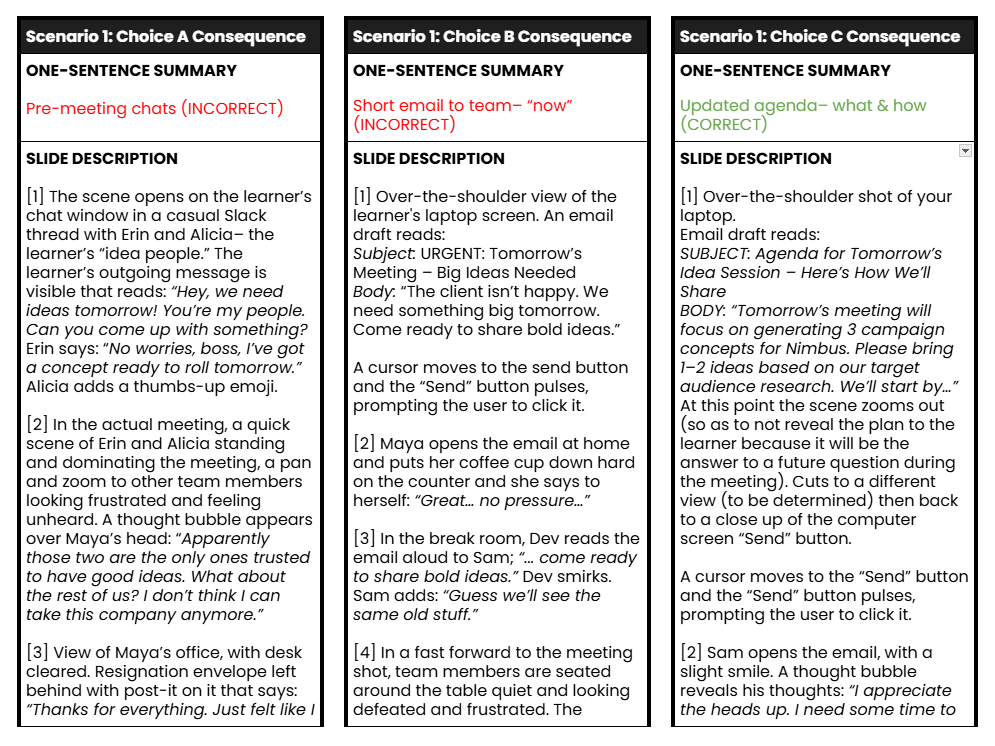
Text-Based Storyboard: Designing immersive decisions and consequence-driven storytelling.
Visual Mockups
I first created a style guide to ensure consistency across characters, color, typography, buttons, and spacing.
Because the visuals relied heavily on Vyond – a video animation platform with a built-in library of customizable characters and environments– I explored and tested those assets early to ensure they supported the story and scenarios.
I then used wireframes and high-fidelity mockups to define and test layouts for each slide type, allowing me to refine balance, hierarchy and spacing before development. This iterative process helped streamline production and contributed to a more polished, cohesive final experience.
I then designed final visual assets and animated scenes in Vyond to maintain immersion.
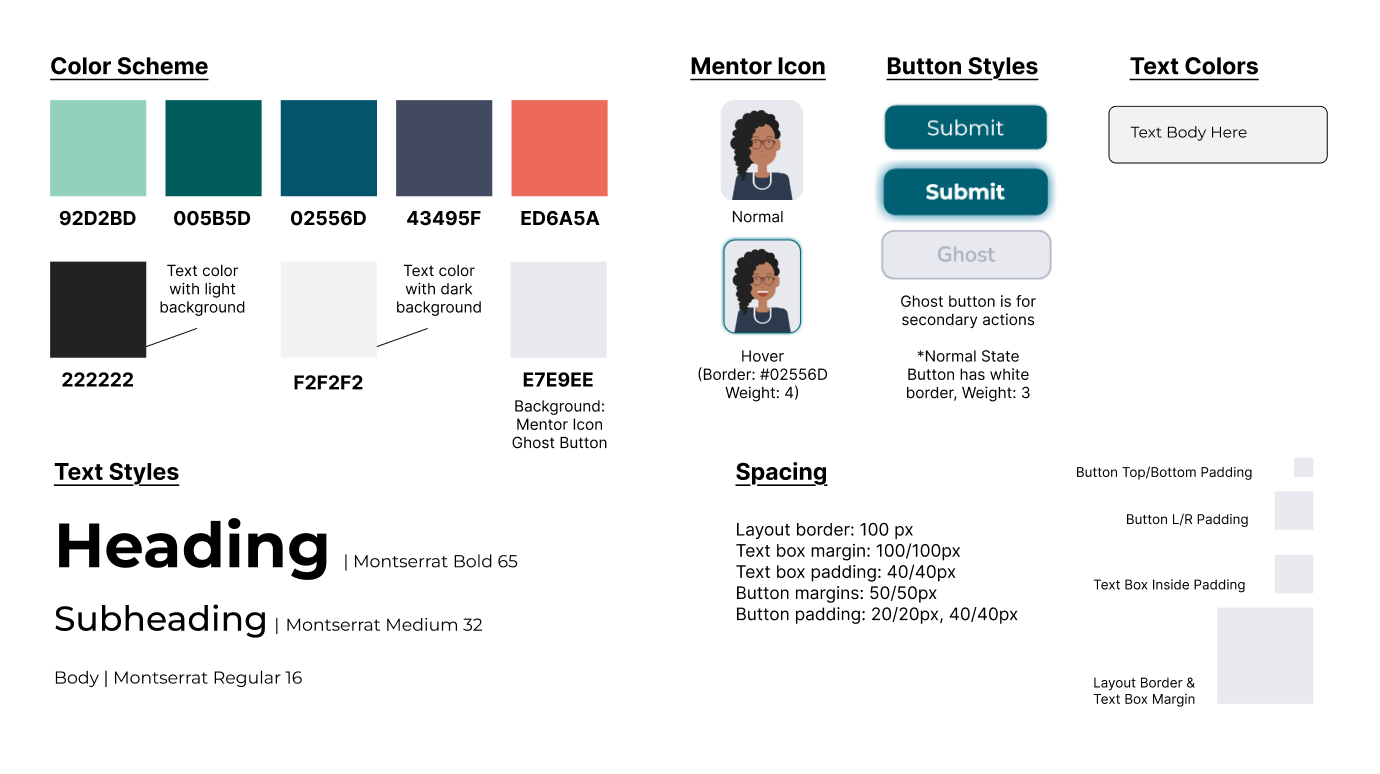
Style Guide: Establishing a consistent visual system to support immersion and clarity.
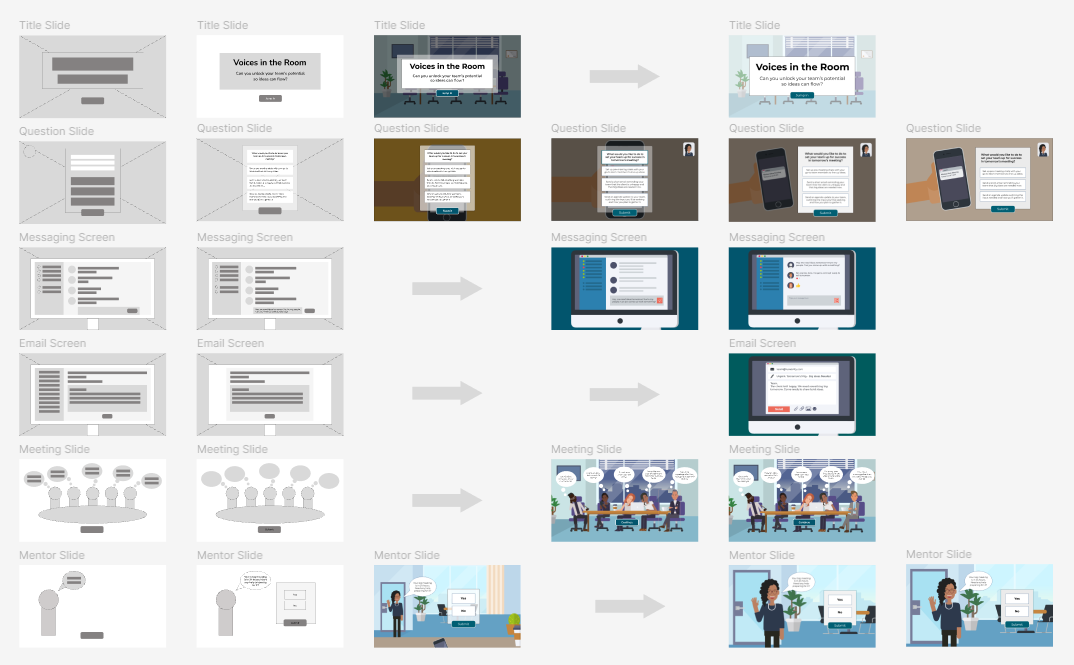
Layout Iteration: Refining six core slide types from concept to final design.
Interactive Prototype
I created an interactive prototype to validate functionality, pacing, and learner experience before full development. This required close coordination between Vyond and Articulate Storyline—a development platform that allows for excellent interactivity. By testing a focused portion of the experience first, I was able to gather feedback and refine structure before investing time in building all three scenarios.
The prototype included a cinematic intro and title sequence, a “meet the mentor” moment, and the first scenario-based decision with its associated consequences. Multimedia learning principles, including Mayer’s coherence and signaling principles, guided design decisions to ensure visuals supported the learning rather than competing with it.
Consequence Montage (Prototype): Testing the cinematic flow of decision outcomes through quick-cut visual storytelling.
Full Development
One key piece of feedback on the prototype centered on the challenge of maintaining learner control of pacing while preserving the immersive, cinematic flow of the story. In response, I refined flow, pacing, and interactions across all scenarios during full development. Before publishing, I conducted three rounds of peer review, each adding layers of refinement. In the first round, for example, a previously undiscovered button behavior edge case surfaced that I resolved.
The final experience included:
263 individually designed video assets, enabling montage-style consequence scenes that help learners feel the human and business impact of their decisions.
Background music integration, reinforcing emotional tone without overwhelming the learner.
Custom JavaScript controls, ensuring smooth, learner-directed transitions while preserving immersion.
Throughout development, multimedia learning principles—such as coherence, signaling, and pacing—guided design decisions to ensure visuals and audio enhanced engagement without competing with the learning experience.
Developer View: Building cinematic interactions and consequence logic in Storyline and Vyond.
eLearning Walkthrough: In this video, I break down how I designed this cinematic, story-driven experience.
Results and Takeaways
Because this was a concept project, I collected no live data. If implemented with a real client, evaluation would focus on observable behavior change—how leaders structure meetings, invite participation, and respond to ideas—using manager and peer observations, self-reflections, and pulse surveys. Over time, I would assess these shifts alongside business indicators such as engagement, project performance, and progress toward a 15% year-over-year revenue growth goal.
A key takeaway was the value of designing for action rather than awareness, and of using consequence-driven storytelling to make leadership behaviors—and their impact—visible, memorable, and transferable to the workplace.
Personal Reflections
Problem-Solving: I really enjoyed the problem-solving process of working in Storyline and integrating custom JavaScript to support background audio during consequence scenes. The music brought energy and emotional weight to those moments—without it, the impact wouldn’t have been nearly as strong.
Storytelling: I also loved the challenge of crafting characters and a story that learners could connect with and care about. Creating narrative tension while balancing realism and relevance pushed my skills in new ways.
Personalization: If I were to iterate on this project, I’d explore ways to further personalize the experience—perhaps with an initial self-assessment to guide scenario pathways or deeper branching logic that tailors feedback to individual learning needs.
AI-Generated Assets: Finally, I’m looking forward to opportunities to explore tools beyond Vyond (wordplay intended). I’m especially interested in leveraging AI-generated asset collections and other emerging technologies to create even more customized and immersive visual experiences.